





The type of rail is expressed in kilograms of rail mass per meter of length. The rails used in my country’s railways are 75kg/m, 60kg/m, 50kg/m, 43kg/m and 38kg/m.
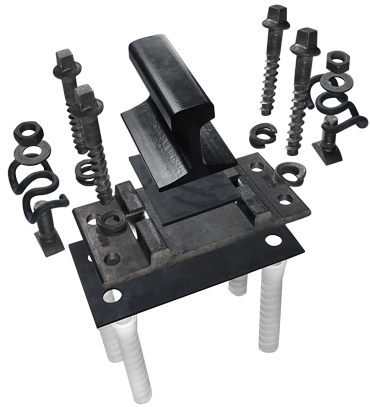
The section shape of the rail adopts an I-shaped section with the best bending resistance, which is composed of three parts: the rail head, the rail waist and the rail bottom. In order to make the rail better withstand the forces from all sides and ensure the necessary strength conditions, the rail should have sufficient height, its head and bottom should have sufficient area and height, and the waist and bottom should not be too thin.

In addition, in order to meet the needs of structures such as turnouts, extra-large bridges and seamless lines, my country’s railways also use special-section (asymmetrical I-shaped with the central axis) rails. The most commonly used rails are short and special section rails, referred to as AT rails.
Rail transportation
How are the long rails produced and transported?
There are usually two ways.
The long rail transport special vehicle is a special transport vehicle manufactured for long rail railway transportation. Since its production, there have been T11, T11A, T11B, T11BK and other products. The T11 was first put into use in 1988 by the Beijing Railway Bureau. It was used, and it became the T11A type after an improved design. The T11B type is formed on the basis of the T11A type by partially improving the design of the vehicle group and adding a working vehicle. The T11BK model is based on the previous generations of models, and has been comprehensively improved in terms of body structure and on-board facilities, and adopts technologies such as K2 bogies.
With the large-scale construction of high-speed railways and passenger dedicated lines in my country, the problem of insufficient transport capacity of special vehicles for long rail transportation is very prominent. Therefore, starting from 2002, organized by the Ministry of Railways, and with the unremitting efforts of researchers from China Academy of Railway Sciences, the technology of long-rail ordinary flat wagons has finally been developed. Flat car transport loading reinforcement scheme
- 7 Essential Rail Maintenance Equipment Every Railway Contractor Should Know

- 6 Component Parts of Railway Track You Should Know

- Three Doubts You Should Clarify About Railway Tracks.

- 5 Things You Probably Didn’t Know About Crane Rail.

- Secret on Bridge Crane Rail

- Everything you should know about BS 100a rails

- How Railway Tracks Are Made

- How Often Do Railroad Tracks Need To Be Replaced?

- How Much Is Rail Track?

- Gantrex Clips Review

- What do you know about crane rails solution?

- Everything You Need to Know About the Thermit Welding Process for Railroad Tracks
