






- Type: rubber rail pad, HDPE rail pad, EVA rail pad, crane rail pad.
- Material: Rubber, HDPE, EVA.
- Size: Custom types.
- Packing: According to requirements.
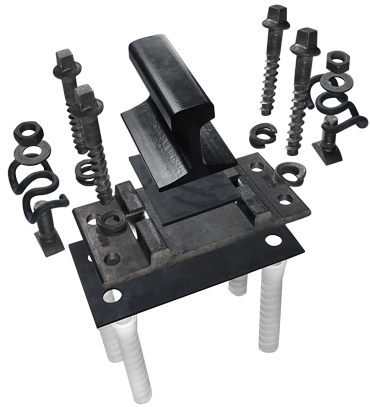
Railway pads always play a key role in rail fastener system. It’s a bedding device between the rail track and the railway sleeper (or railroad tie), which ensures the railway safely and stably operates by providing cushion and support.


As a professional and veteran rail fastener manufacturer, AGICO has been certified by iso9001/2008. Up to now, we have more than 130 sets of machines in our railway pads production lines, and the annual production capacity can reach 2, 000, 000 sets. Our product serves clients all over the world and gets unanimous praise.
Our railway pads have a wide range of materials and types, such as rubber rail pad, HDPE rail pad, EVA rail pad, crane rail pad, etc. And there are two patterns for your selection- grooved or studded. They are suitable for various models of high-speed rails, regular rail, and crane rail.
We support custom-made products. No matter what type of rail pads you need, we have the solution for all requirements.
HDPE Railway Pad


The following are the HDPE pad detailed parameters:
| Technical Parameter | Unit | Technical Requirement | Value |
| Density | g/cm3 | 0.95-0.98 | 0.95 |
| Tensile Strength | Mpa | ≥19 | 19 |
| Elongation | % | >80 | 150 |
| Melting Point | ℃ | 170-190 | 190 |
| Insulation Resistance | Ω | ≥1×10¹⁰ | 3.5 ×10¹⁰ |
| Hardness | A | ≥98 | 98(A) |
HDPE pad features and advantages
HDPE pads have high strength, wear resistance, aging resistance, and good weather resistance features.
Simultaneously, they possess durability, lightweight, easy-to-process, and easy-to-install advantages.
HDPE pad uses
Based on HDPE pad features, HDPE pads are suitable for railways with high load capacity requirements, and they perform especially well in high or low-temperature environments.
Generally, HDPE pads are widely used in high-speed railways, heavy haul railways, and mainline railways, and they are suitable for E-type, SKL, KPO standard rail fastening systems.
Rubber rail pad


The following are the rubber rail pads’ detailed parameters:
| Technical Parameter | Unit | Value |
| Stiffness | KN | 90-130 |
| Hardness Shore A | ℃ | 72-80 degree |
| Electronic Resistance | Ω | ≥ 106 |
| Tensile Strength Before Aging | Mpa | ≥12.5 |
| Elongation before Aging | % | ≥250 |
Rubber rail pad features and advantages:
Rubber rail pads adopt synthetic rubber material, and possess high elasticity, wear resistance, aging resistance, and good weather resistance features.
Their advantages are equipment with excellent capacity for damping effect, noise reduction, and adapting to extreme weather conditions.
Rubber rail pad uses
High-speed tracks and heavy-haul railways: Rubber pads’ high elasticity and wear resistance are suitable for high-speed and high-load railways.
The special type of tracks: Rubber pads also perform outstandingly in lines with high damping requirements, such as bridges and tunnels.
They generally apply to rail fastening systems with high requirements, such as E-type, SKL, KPO, Nabla, PR rail fastening systems, etc.
EVA railway pad


The following are the EVA pads’ detailed parameters:
| Technical Parameter | Unit | Technical Requirement | Value |
| Density | g/cm3 | 0.95-0.98 | 0.95 |
| Tensile Strength | Mpa | ≥15 | 16 |
| Elongation | % | >500 | 550 |
| Melting Point | ℃ | 170-190 | 170 |
| Insulation Resistance | Ω | ≥1×10¹⁰ | 5.0 ×10¹⁰ |
| Hardness | A | ≥90 | 92(A) |
EVA pad features and advantages
EVA pad uses ethylene-vinyl acetate copolymer material, its features are high elasticity, wear resistance, aging resistance, and good shock absorption performance.
As for EVA pads’ advantages, EVA pads can absorb impact and shake, and reduce noise efficiently, thus improving the ride comfort.
EVA pad uses
- Urban railway system: EVA pads are suitable for subway and light rail systems, they can provide splendid shake absorption and noise reduction effect.
- Bridges and tunnels: EVA pads’ elasticity and shake absorption are suitable for application in bridges and tunnels with large structural vibrations.
Why choose us


- Complete specifications and various sizes of rail pads.
- Support customization.
- Reasonable prices.
- Rich experience process perfection and quality guarantees.
- Sufficient stock and delivered rapidly.
- Professional technical support and engineer team.
Railway pads working principle
The railway pad working principle is mainly based on the railway pad materials’ elasticity and their structure design:
When trains pass, railway pads will have an elastic deformation. This kind of deformation can absorb the trains’ dynamic load, and reduce causing strict impact on the rails and the tie.
What’s more, the materials of railway pads, like rubber, EVA, or HDPE, all have a great capacity for absorbing and dispersing energy. When the train contacts the rail pad, the railway pads absorb and disperse the energy to decline the railroad track systems’ integral shake and noise.
After the train passes, the railway pad will be restored to its original shape and state. That ensures the railway pad’s durability and stability during long use.
Railway pads function
- Shock absorption and buffering, protect rails and sleepers, reduce the maintenance cos
- Enhance the rail systems’ stability
- Noise reduction effect
- Improve ride comfort
- Adopt different kinds of weather conditions