





Rail maintenance equipment refers to the professional equipment used in railway maintenance, including rail gap adjusters, rail benders, rail lifting equipment, rail tamping machines, rail tensioners, rail cutting machines, rail grinding machines, rail drilling machines, etc. The stable operation of the railway track needs regular and careful track maintenance; all these rail maintenance equipment plays a vital role during railway track maintenance.

Why is rail maintenance equipment important for the railway track?
Firstly, rail maintenance equipment can promptly detect and repair various diseases on railway lines, such as track irregularities, roadbed settlement, bridge cracks, etc. Through timely maintenance and upkeep of track maintenance equipment, railway lines can be ensured to be in good condition, improving the smoothness and safety of train operation.
Secondly, rail maintenance equipment can also conduct regular inspections and tests on railway lines. These inspections and testing work can timely detect potential safety hazards, such as foreign objects on the track, signal equipment failures, etc., thereby avoiding accidents. Through the inspection and testing of road maintenance equipment, the safety status of railway lines can be fully controlled, providing strong guarantees for the safe operation of trains.
In addition, rail maintenance equipment can also improve the efficiency and quality of railway maintenance work. Traditional railway maintenance work often requires a large amount of manpower and material resources, and the quality of maintenance is difficult to guarantee. The application of road maintenance equipment can greatly reduce the investment of manpower and material resources, and improve the efficiency and quality of maintenance work. This can not only reduce railway maintenance costs but also improve the reliability and economy of railway transportation.
Therefore, it can be said that rail maintenance equipment is the “guardian” of railway transportation safety, playing an irreplaceable role in ensuring railway transportation safety.
Rail grinding machine
The rail grinding machine is primarily used to polish the unevenness of rail welding joints, both new and old. Repeated grinding of the rail surface increases the contact area between the wheel and rail, improving the smoothness of train operation.

Like professional equipment for “SPA” for steel rails. The grinding wheel at the bottom of it is like a precise “surgical knife”, which can adjust the grinding angle and force according to the degree of wear, cracks, or fat edges of the steel rail. By high-speed friction between the grinding wheel and the surface of the steel rail, it is like “polishing and shaping” the steel rail, restoring its smoothness and smoothness, making the contact between the train wheels and the steel rail more in line, reducing the friction noise during train operation, and “renewing” the steel rail to ensure the smoothness of the track.
Data shows that the scientific use of rail grinding machines for maintenance can extend the service life of rails by more than 30%, while significantly reducing vibration and noise during train operation, and improving passenger riding experience.
Rail tamper
In order to disperse the stress generated by trains passing through the track, ensure safe operation, and protect the steel rails, stones of moderate size will be used to lay ballast on the track, and a railway tamping machine is a powerful tool for laying ballast.

The rail tamper can not only compact ballast, but also be used to crush concrete, asphalt, compacted soil, etc. It is a reliable assistant for railway workers.
The appearance of the rail tamping machine may seem bulky, but its long “fangs” are not at all vague when it comes to fighting against gravel, earning it the title of “Cobra” and naturally being the “handle” of the tamping pickaxe world.
It is a “good helper” for engineering personnel to carry out road compaction, daily line maintenance, and repair line level, height, and triangular pits and other line diseases. It can compact the track with high-frequency and high-energy vibrations, and after replacing the chisel, it can also be used for crushing the slab track bed in the replacement of rail sleepers.
Rail bolt wrench
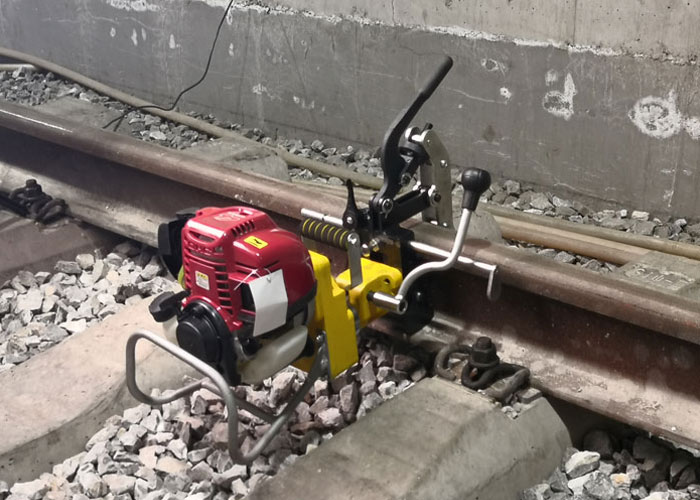
The rail bolt wrench looks like an armored vehicle, but it cannot go up or down mountains or rivers. Tightening bolts is its specialty.

During the centralized maintenance period of the railway track line, this tool is frequently used. It is easy to operate and has powerful functions. It can simultaneously tighten or loosen the sleeper screw on both sides of the rail. Whether it is loosening rail bolts or fastening fasteners, it can be easily handled, greatly improving work efficiency and providing strong guarantee for the smooth progress of the centralized maintenance work of the railway line.
Rail drilling machine
Hard steel rails are not worth mentioning in front of it, and internal combustion rail drilling machines can quickly and easily complete drilling operations in the rail waist area.

In maintenance work, sometimes it is necessary to replace the steel rails on a small section of the line. Drilling is done to connect the new and old rails through joint clamps and joint bolts.
Why drill holes on intact steel rails? This is not about causing damage, but rather during maintenance operations where it is sometimes necessary to replace small sections of steel rails. Drilling is done to connect the new and old rails through rail fish plate and fish bolts. The internal combustion rail drilling machine and the internal combustion rail cutting machine can be called “golden partners”.
Rail cutting machine
The rail cutting machine is the “surgical knife” of the “rail doctor”, with precise positioning. When the knife is lifted and lowered by hand, the hard rail is divided into two parts. It is an essential “artifact” for track changing operations, producing dazzling sparks when cutting steel rails, and becoming a unique scenic spot in track changing operations.

Railway track lifting and lining machine
The railway hydraulic lifting and lining machine is an important tool in railway maintenance, mainly used to adjust the level and position of the track. It provides strong thrust through a hydraulic system and can easily lift or move heavy rails. Railway track lifting equipment plays an irreplaceable role in daily maintenance, major repairs, and emergency repairs of railways.

Common models include YQB series, YQD series, and YQ series. These models have their own design focuses and are suitable for different work scenarios. For example, the YQB series is typically used for small-scale maintenance operations, while the YQD series is more suitable for large-scale railway maintenance projects.
Track gauge tool
Track gauge tool, also known as “track gauge rule”, is one of the commonly used tools in railway construction and daily railway maintenance. It is mainly used to measure the error of track gauge and the difference in level between two steel rails on the line, and plays an important role in maintenance operations. It can be regarded as a “sharp tool” for railway workers, the most important tool for engineering personnel, and the slightest change in the track relies on its “command” adjustment.

As the saying goes, to do a good job, one must first sharpen one’s tools. With the development and progress of railway technology, railway maintenance equipment is constantly changing. With them accompanying railway personnel, railway transportation is safe, stable, and worry-free. What other railway maintenance equipment do you want to know? Welcome to contact us for more information.